
Phuong Dao
- Assisant Professor
- Integrative Biology
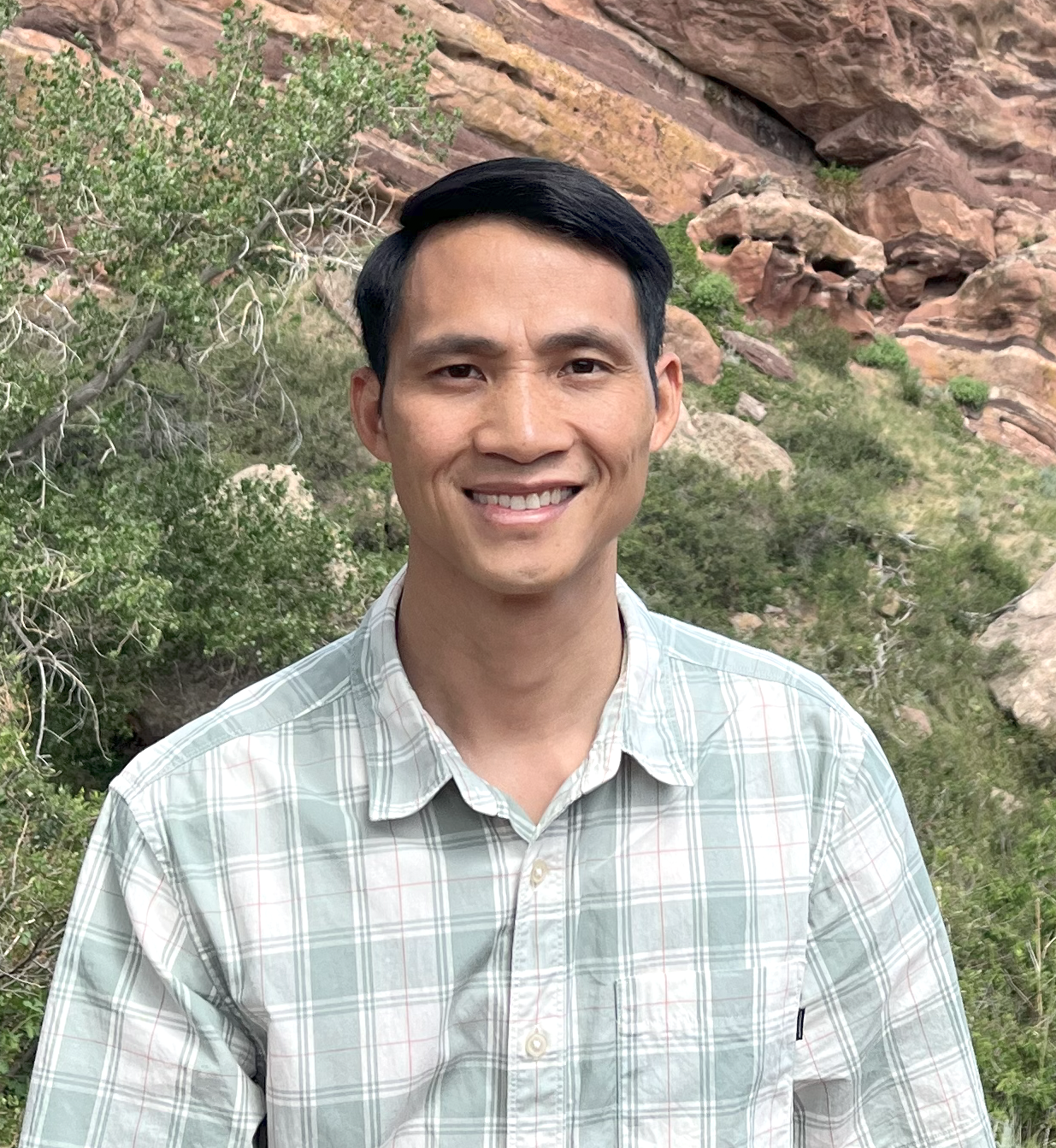
Contact Information
Biography
I am Dr. Phuong Dao, an Assistant Professor and the principal investigator of the Remote Sensing and Environmental Intelligence Lab (ReSEIL) in the Department of Integrative Biology, College of Natural Sciences, The University of Texas at Austin. Before joining UT Austin, I was an Assistant Professor in the Department of Agricultural Biology, Colorado State University. At CSU, I was also a Faculty in the School of Global Environmental Sustainability and the campus-wide Graduate Degree Program in Ecology. I also developed and advised the Agricultural Data Science undergraduate minor program at CSU. Before joining CSU, I was a Postdoc at the University of Wisconsin-Madison (with Prof. Philip Townsend) and NSF-ASCEND Biology Integration Institute (currently a partner) that is directed by Prof. Jeannine Cavender-Bares (Harvard University), Prof. Philip Townsend (UW-Madison), and Prof. Peter Reich (University of Michigan). I earned a dual PhD degree in Physical Geography and Environmental Studies from the University of Toronto in Canada with the Connaught International Fellowship.
Research
I am a remote sensing and geospatial scientist and a plant ecologist. I am broadly interested in understanding how plant-disturbance interactions and plant chemical response at the species level impact plant health, growth, and functioning by integrating multi-source remote sensing, geospatial science, genetic and molecular methods, biological modeling, and machine learning.
Research Areas
- Biodiversity, Ecology or Sustainability
- Climate Change
- Artificial Intelligence and/or Robotics
Fields of Interest
- Plant Biology
- Ecology and Global Change Biology
- Computational Biology
- Artificial Intelligence & Machine Learning
- Image Analysis
Education
- Postdoc, The University of Wisconsin–Madison, 2023
- Postdoc, NSF-ASCEND Biology Integration Institute, 2023
- Ph.D., The University of Toronto, 2021
Publications
Selected publications (full publications: Google Scholar Page):
Cherif, E., Kattenborn, T., Brown, L., Ewald, M., Berger, K., Dao, P.D., Hank, T.B., Laliberté, E., Lu, B., Feilhauer, H. 2026. Uncertainty assessment in deep learning-based plant trait retrievals from hyperspectral data. Biogeosciences, 23(7), 2235–2259.
Tran, T.V., Reef, R., Zhu, X., Dao, P.D. 2026. Hybrid nature–infrastructure adaptation shapes multidecadal mangrove–shoreline dynamics in a tropical delta. Communications Earth & Environment (Nature Portfolio).
Dinh, D.Q., Kunk, D., Hy, S.T., Nalam, V.J., Dao, P.D. 2026. DiscoEPG: A Python package for characterization of insect electrical penetration graph (EPG) signals. Smart Agricultural Technology, 13, 101874.
Abdalla, A., Todd, O.E., Pennam, S.V.P.K., Hoopes, E., Nguyen, N.T., Dorn, K.M., Dao, P.D. 2025. All-in-one machine learning framework for early detection and characterization of sugar beet diseases using hyperspectral imaging. Smart Agricultural Technology,12, 101633.
Mosig, C., Vajna-Jehle, J,…, Dao, P.D.,…, Kattenborn, T. 2025. deadtrees.earth — An open-access and interactive database for centimeter-scale aerial imagery to uncover global tree mortality dynamics. Remote Sensing of Environment, 332, 115027.
Cherif, Y., Ouaknine, A., Brown, L.A., Dao, P.D., Kovach, K.R., Lu, B., Mederer, D.,Feilhauer, H., Kattenborn, T., Rolnick , D. 2025. GreenHyperSpectra: A multi-source hyperspectral dataset for global vegetation trait prediction. NeurIPS 2025 (Datasets and Benchmarks). An A* rank confernece.
Hedberg, S.L., Dao, P.D., Knapp, A.K. 2024. Does within-biome drought sensitivity reflect patterns across biomes? Oecologia, 207(9), 1-12.
Dinh, D.Q., Kunk, D., Hy, S.T., Nalam, V.J., Dao, P.D. 2025. Machine learning for automated electrical penetration graph analysis of aphid feeding behavior: Accelerating Research on Insect-Plant Interactions. PLOS ONE, 20(4): e0319484.
Chadwick, K.D.,..., Dao, P.D., et al. 2025. Unlocking ecological insights from subseasonal visible-to-shortwave infrared imaging spectroscopy: The SHIFT Campaign. Ecosphere, 16(3), e70194.
Dao, P.D., He, Y., Lu, B., Axiotis, A. 2025. Imaging spectroscopy reveals topographic variability effects on grassland functional traits and drought responses. Ecology, 106(3), e70006.
Mederer, D., Feilhauer, H., Cherif, E., Berger, K., Hank, B., Kovach, K.R., Dao, P.D., Lu B., Townsend, P.A., Kattenborn, T. 2024. Plant trait retrieval from hyperspectral data: Collective efforts in scientific data curation outperform simulated data derived from the PROSAIL model. ISPRS Open Journal of Photogrammetry and Remote Sensing, 15, 100080.
Cherif, e., Feilhauer, H., Berger, K., Dao, P.D., Ewald, M., Hank, T.B., He, Y., Kovach, K.R., Lu, B., Townsend, P.A., Kattenborn, T. 2023. From spectra to plant functional traits: Transferable multi-trait models from heterogeneous and sparse data. Remote Sensing of Environment, 292, 113580.
Dao, P.D., Axiotis, A., He, Y. 2021. Mapping native and invasive grassland species and characterizing topography-driven species dynamics using high spatial resolution hyperspectral imagery. International Journal of Applied Earth Observation and Geoinformation, 104, 102542.
Dao, P. D., He, Y., Proctor, C. 2021. Plant drought impact detection using ultra-high spatial resolution hyperspectral images and machine learning. International Journal of Applied Earth Observation and Geoinformation, 102, 102364.
Proctor, C., Dao, P.D., He, Y. 2021. Close-range, heavy-duty hyperspectral imaging for tracking drought impacts using the PROCOSINE model. Journal of Quantitative Spectroscopy and Radiative Transfer, 107528.
Dao, P.D., Mantripragada, K., He, Y., Qureshi, F.Z. 2020. Improving hyperspectral image segmentation by applying inverse noise weighting and outlier removal for optimal scale selection. ISPRS Journal of Photogrammetry and Remote Sensing, 171, 348-366.
Lu, B., Dao, P. D., Liu, J., He, Y., Shang, J. 2020. Recent advances of hyperspectral imaging technology and applications in agriculture. Remote Sensing, 12(16), 2659.
Dao, P.D., He, Y., Lu, B. 2019. Maximizing the quantitative utility of airborne hyperspectral imagery for studying plant physiology: An optimal sensor exposure setting procedure and empirical line method for atmospheric correction. International Journal of Applied Earth Observation and Geoinformation, 77, 140–150.